
Pablo Marull
Ideas on economics, financial markets, and long-term investment decisions.
How to Organize Your Monthly Retirement Income?
When a person retires, they stop relying on income earned from employment and begin funding their expenses through income generated by their assets, a pension or retirement benefits, and, in some cases, part-time work.
This transition requires a different approach to personal financial management. The goal is no longer to accumulate wealth but to convert accumulated assets into a stable and sustainable stream of income that can comfortably cover annual living expenses.
In this article, I propose a simple methodology for planning and monitoring retirement income using two complementary worksheets: one for annual planning and another for periodic monitoring.
The Two Sources of Investment Returns
Every investment generates returns in one or both of the following ways:
-
Income, such as interest, rental income, dividends, or pension payments.
-
Capital gains, which represent the increase in an asset's value while it is held or when it is sold.
Income is generally more predictable, while capital gains depend on market performance and are therefore less certain.
Income-Producing Assets
Examples include:
-
Bonds, which pay interest monthly, semiannually, or annually.
-
Rental properties, which generate monthly rental income.
-
Private loans, where the lender receives interest over the life of the loan.
-
Pensions or retirement benefits, which provide income defined by law or contract.
-
Part-time employment, which may generate relatively stable income depending on the nature of the work.
Capital Appreciation Assets
Examples include:
-
Stocks, whose returns come from share price appreciation and, in some cases, dividend payments.
-
Private businesses or ownership interests, where returns depend on the growth in the business's value and its eventual sale.
Worksheet 1: Annual Income Planning
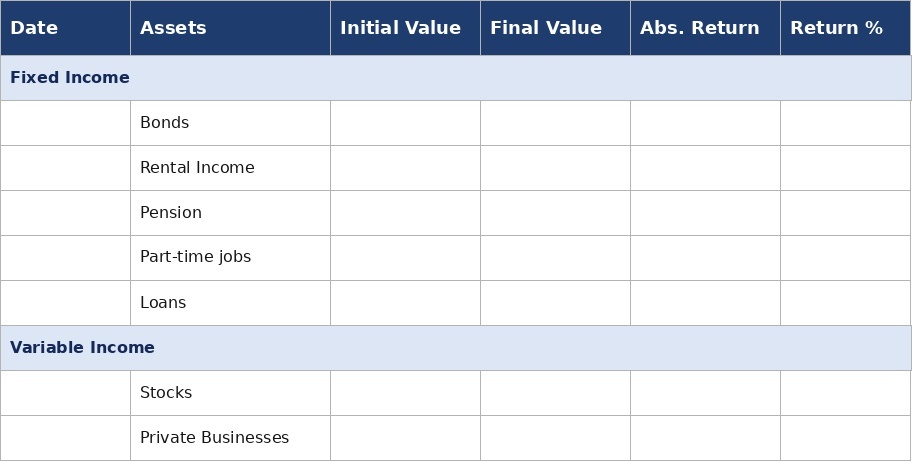
At the beginning of each year, it is useful to prepare a worksheet estimating the expected income generated by each asset.
For income-producing assets, estimate the interest, rental income, pension payments, and any other predictable cash flows. For growth-oriented assets, estimate both expected dividends and a reasonable projection of potential capital gains.
The key question is:
Will the expected return from my portfolio be sufficient to cover my annual living expenses?
This worksheet provides a snapshot of your financial situation at the beginning of the year and serves as the foundation for your retirement income plan.
Worksheet 2: Periodic Monitoring
Because no forecast is perfect, it is equally important to maintain a second worksheet that is updated monthly or quarterly, depending on the amount of time you wish to dedicate to managing your finances.
This worksheet should record:
-
Interest, rental income, dividends, and other income actually received.
-
The current market value of all open investments.
-
Investments that have been sold or matured during the year, which should be transferred to a separate record of closed investments.
At year-end, the results of closed investments should be incorporated into the portfolio's overall annual performance.
This worksheet is dynamic because investments are continually being opened, closed, or producing returns that differ from the original expectations.
Why It Is Important to Separate Income-Producing Assets from Growth Assets
At the bottom of both worksheets, it is helpful to calculate separately the total return generated by income-producing assets and by growth-oriented assets.
This distinction is important because retirement expenses also fall into two broad categories:
-
Fixed expenses, such as housing, food, healthcare, insurance, and taxes.
-
Discretionary expenses, such as travel, gifts, entertainment, and other optional purchases.
Ideally, income generated by income-producing assets should cover most—if not all—of your fixed living expenses. This provides greater financial stability and reduces the need to sell investments during unfavorable market conditions.
When a significant portion of a retiree's portfolio is invested in growth assets, a prudent strategy is to use the capital gains realized during one year to help finance expenses in the following year, rather than relying on those gains to meet current monthly expenses.
Conclusion
Retirement requires a shift in mindset—from managing a paycheck to managing a portfolio.
Maintaining both an annual planning worksheet and a periodic monitoring worksheet provides a clear understanding of where retirement income comes from, whether the portfolio is generating sufficient returns to support spending needs, and whether adjustments are needed during the year.
Beyond measuring investment performance, the greatest benefit of this approach is that it brings organization, discipline, and peace of mind. A well-structured retirement income plan reduces financial stress, improves decision-making, and helps ensure that your portfolio continues to fulfill its primary purpose throughout retirement: providing long-term financial security and a high quality of life.
