
Pablo Marull
Ideas on economics, financial markets, and long-term investment decisions.
Harry Browne Permanent Portfolio Returns
This portfolio is designed to generate attractive long-term returns while seeking to minimize volatility and reduce the severity of drawdowns over time. In other words, it is built to provide a smoother investment experience and help investors sleep well at night, even during periods of market uncertainty.
The portfolio achieves this objective through a diversified asset allocation approach, balancing growth opportunities with risk management considerations. The allocation is as follows:The allocation: 25% Stocks · 25% Long-Term Treasuries · 25% Short-Term Treasuries (cash) · 25% Gold.
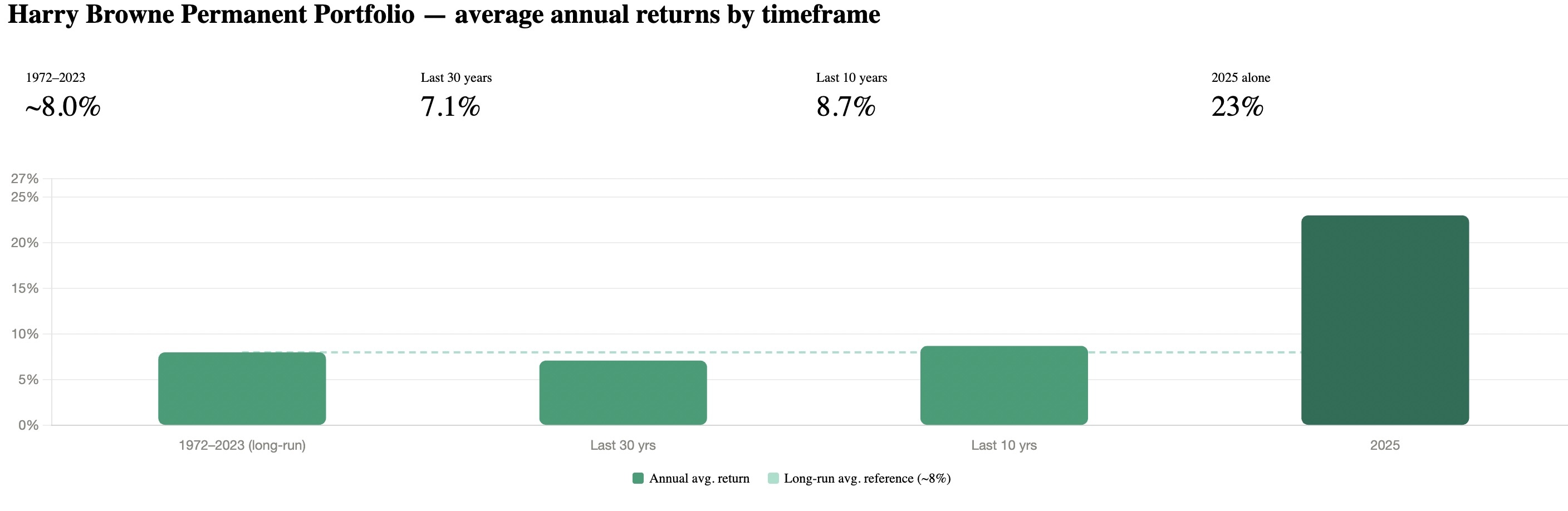
Key risk metrics (30-year data):
Volatility (Std. Dev.): ~6.8% — roughly half that of the S&P 500
Max drawdown: ~-16%, recovered in ~27 months
Why it works across cycles
Each asset is designed to shine in a different economic environment: stocks provide strong returns during prosperity, long-term Treasuries do well during deflation, cash (short-term Treasuries) hedges against recession and tight money, and gold protects during inflation.
Recent tailwinds
2025 was the portfolio's best single year since 1979, returning 23%, driven by a 15% S&P 500 gain, falling long-term Treasury yields, gold surging 65%, and short-term notes yielding between 3.8%–4.3%.
The trade-off
The relatively low 25% stock allocation means equities don't have enough room to drive strong returns, especially for younger investors with a long time horizon and high risk tolerance. A pure S&P 500 index fund has historically returned ~10–11% annually, but with far greater volatility and drawdowns (e.g., -44% in 2000–2002, -37% in 2008).
Bottom line: The Permanent Portfolio is a low-volatility, all-weather strategy averaging roughly 7–8% annually over the long run — solid returns with notably smoother rides than a stock-heavy portfolio.
